In her own words
Sierra Leone: a trip down memory lane
Stella Din-Jacob on covering the civil wars of the Mano River Union countries, from the Lome peace agreement to the people she met along the way.
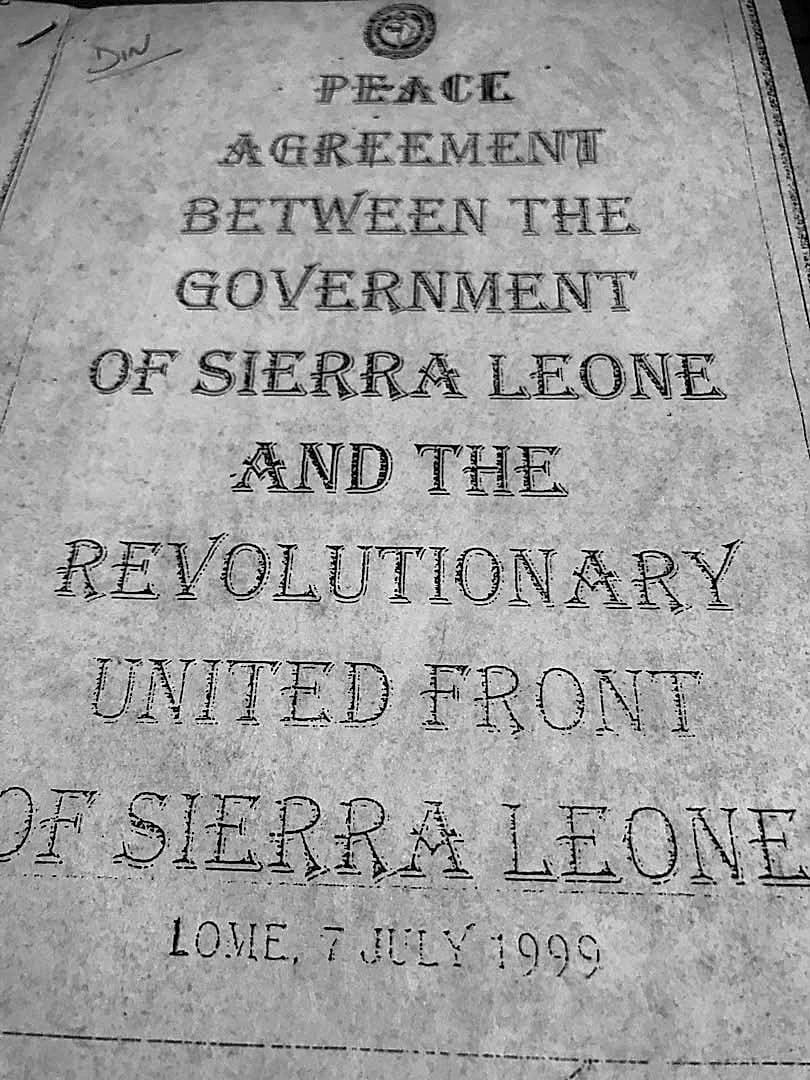
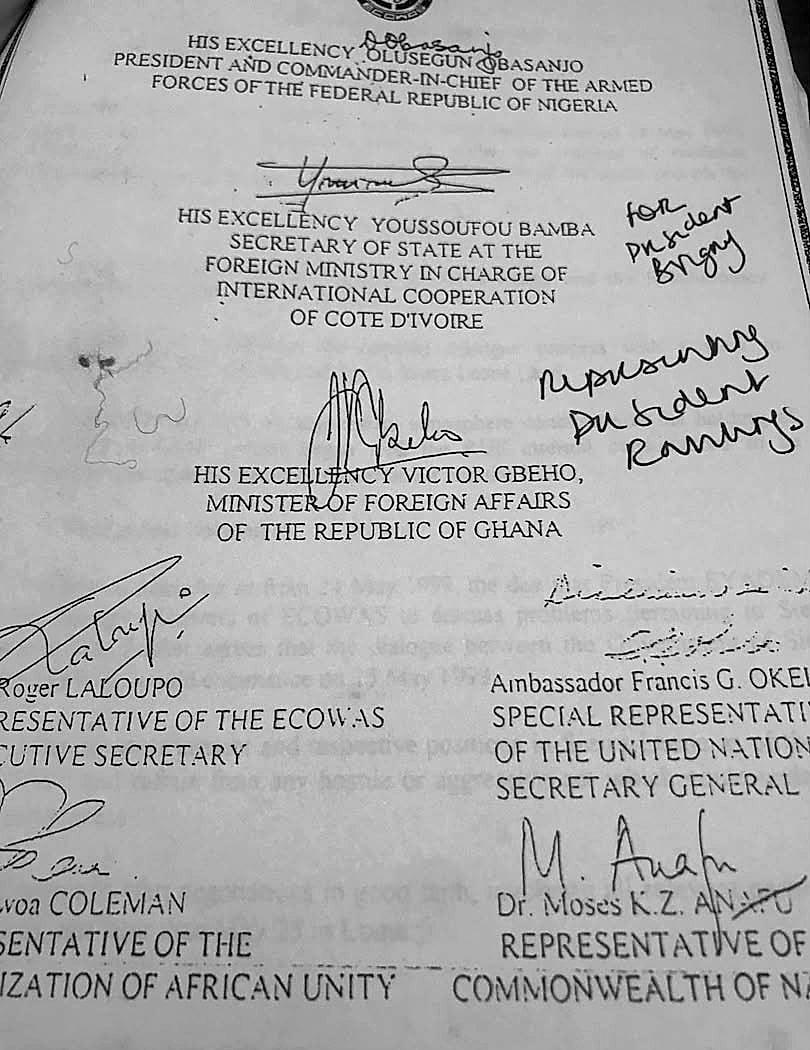
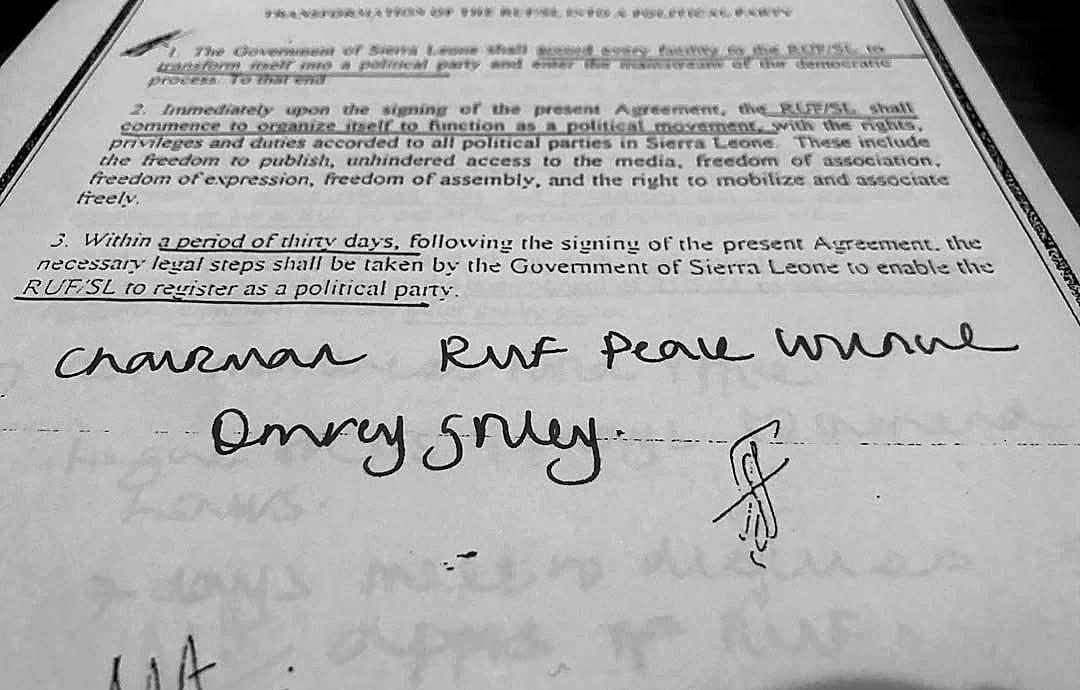
Taking a trip down memory lane after I found this original copy of the historic agreement signed between the Government of Sierra-Leone and members of the Revolutionary United front in Lome, the Togolese capital.
I remember this day so clearly when President Tejan Kabbah with tears in his eyes held Baby Fatimata (the girl whose limbs were hacked) and pleaded for hostilities to cease!
The happiest moments of my career as a foreign affairs correspondent were spent covering the civil wars across Mano River union countries and the West African sub region. It was in Sierra Leone that I met so many people whose unique stories touched the essence of my being and gingered me to keep the focus and spotlight on the attempts at peace, which saw me interview Foday Sankoh, Johnny Paul Koroma, Hinga Norman, Sam Bockarie, Omrie Golley, Joe Blell, Solomon Berewa, Gen Veejay Jetley, Julius Spencer, Lansana Kouyate, Gen Agwai, Charles Taylor, Monie Captan, Sam Kargbo, Khaddir Bassir, Kumba Mondeh, Kelvin Lewis, Amb Howard Jeter, the SRSG Amb Olu Adeniji, Amb Said Djinnit from the OAU and later African Union and many more. It was here that I realized that Civil conflict would rage and end but leave society poorer for it.
I remember the ambush on my truck and my cameraman Stanley Adigbolo (May his soul Rest In Peace) and I remember the bomb explosion at the barracks with Gen Khobe, Francis Anyigbe and I sitting in the back of the General’s Korando. I remember the many rides aboard ‘Charlie’ and one scary attempt at landing in the dead of night and the hydraulics of the C-130 transport plane malfunctioning as we approached Lungi airport.
I recall these incidents and remember the wonderful people especially the Bahsoun family who opened their homes to me, Fed me, kept me safe and gave me the insight into the complex issues that snowballed into this human tragedy.
I remember going to the Caritas camp to meet with the young boys who became unwilling participants in this brutal war – they went by such dreadful names – OC the Killer, OC Molest, OC Torture but when they had to sing a song they composed atoning for their part in this conflict that raged with intense ferocity, it only reinforced the need to reflect deeper and humanize the stories that came out of our backyard. I remember so well getting to Rogbere jct after an attack and met a young lady called Maimunatu Kamara who lost her limbs but lived to tell the story of how her family was decimated – I remember Mrs Elizabeth Alpha Lavalie whose personal losses galvanized her into action in word and deed as she became active in the Mano River Union women’s network campaigning for peace and stability.
The memories of my trips are shouting out at me now as I recall yet another close shave with General Bomb-Blast in Okra hills and Capt Dumbuya who went by the nom de Guerre ‘Savimbi’ because of his uncanny resemblance to the Angolan war lord Jonas Savimbi.
I recall having breakfast with Foday Sankoh the leader of the RUF at the Hotel 2 Fevrier and a subsequent interview where he told me that he was all for peace. That was the day he took the time to tell me the story of his life and his ideology. He was a soft spoken man, who had impeccable manners. I found it hard to marry Sankoh up close with the villain that many in Sierra Leone and beyond saw him. I had his phone number and visited his spur road residence to the consternation of many who assumed I was fraternizing with a man who eroded humanity in the most callous and brutal persecution of his war on innocent bystanders.
And in Liberia it was another experience when we became the news. It was with Thomson Ogba, my experienced and passionate cameraman that I shared another horrible experience in a hotel on Broad Street in Liberia’s capital Monrovia where Charles Taylor’s secret police manhandled us and practically dragged me out of the bathroom – but for Col Luka Yusuf – who rescued us and was daggers drawn with Taylor’s hit-squad, we may have been history. We were ‘extracted’ from the hotels on Broad Street under heavy escort in trucks belonging to and American company (Pacific Architects for the Environment). We were taken to the Nigerian Contingent mess across the Montserado Bridge where we made do with uncomfortable make shift beds until it was time to go back home.
Before this adventure in Monrovia, some of us had endured terrifying rides aboard a helicopter gunship flown by mercenaries across Makeni, Bo and Kenema – over enemy territory. One thing was certain – we were eager to tell the story and were unperturbed even when danger was on the horizon.
One day I may just write a book which will be my contribution to history. I will remain grateful to Mr and Mrs John Momoh – under whose guidance as an employee of Channels Television gave me the wings to soar, both are seasoned professionals who continue to redefine Africa’s media landscape and can hold their own universally. Their work ethic, professionalism and sense of responsibility tempers my raison d’etre as I seek to grow as a broadcaster and attain the nadir for which they have continued to raise the bar and smash any and every glass ceiling.
This journey began to tell a story but at the end of it, I became the journalist from Nigeria who wanted to keep in the consciousness of everyone the horrible tragedy that was unfolding. I saw women cry for other women whose unborn babies were yanked from their stomachs. I recall with horror and angst when rebels marched on Freetown the capital and the deafening sound of gunfire ringing out in the dead of night. I remember being in the frontline with Nigerian soldiers mourning their fellow officers and men and the sense of loss that would envelope and loom large over the horizon – at some point I became numbed by the tragedy unfolding and the inability of the actors in this complex theater of war to realize that a line had been crossed.
At the time Sierra Leone was on the brink – the world’s super powers had East Timor, Kosovo, and the Bosnia – Herzegovina crises to contend with. So it was up to big brother (our beloved Nigeria) to stabilize the region and save the day.
Have we as a continent taken stock of why these issues continue to define us? Have we spared a thought for the cost of rebuilding and rehabilitating persons who were internally displaced, emotionally scarred and forced into exile because of the events which saw internal unrest degenerate across multiple borders?
The price to pay for war and civil strife in any way is unquantifiable – and the collateral damage obvious long after the guns of war fall silent and actors spent.